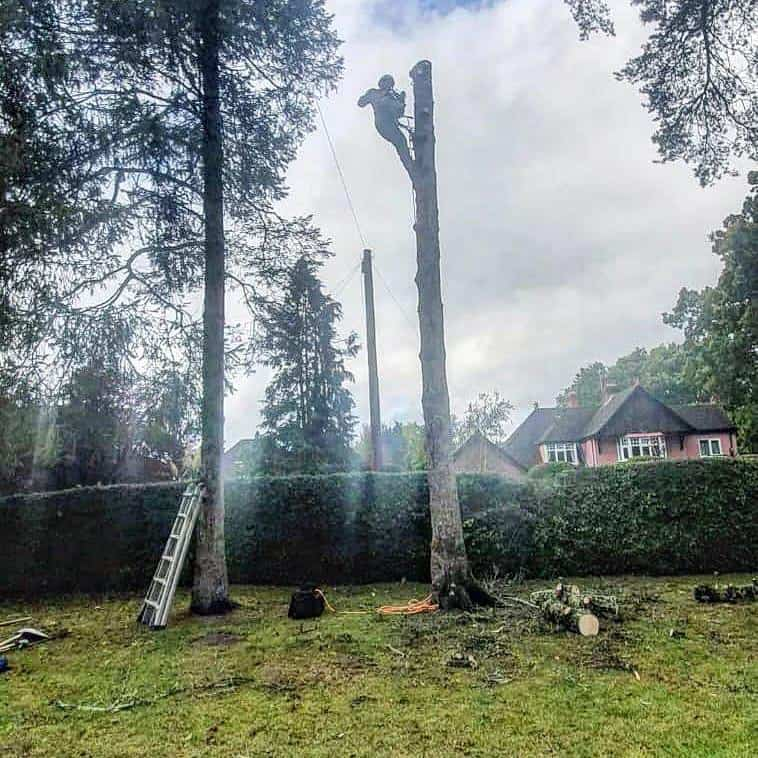
An overgrown tree can dominate a garden, reduce natural light and place excessive growth close to buildings, boundaries or other plants. However, reducing its size is not simply a matter of cutting back every large branch. The correct approach depends on the tree’s species, condition, structure and position.
For property owners in Aldershot, Hampshire, professional tree surgery can provide several ways to manage an overgrown tree while protecting its health, appearance and natural form.
Professional Options for Managing an Overgrown Tree
An experienced tree surgeon will assess the entire tree before recommending any work. This includes examining its overall shape, branch structure, health and relationship with the surrounding garden.
Crown Reduction
Crown reduction decreases the height or spread of a tree by shortening selected branches. Cuts are made back to suitable growth points so the tree retains a balanced and natural outline.
This approach may be suitable when a tree has outgrown its available space, become unbalanced or developed branches that extend too far towards nearby features. The amount removed must be carefully judged, as excessive reduction can leave the tree stressed and encourage weak regrowth.
Crown Thinning
Crown thinning involves selectively removing smaller branches throughout the canopy without substantially changing its overall size or shape. It reduces the density of the crown while maintaining a balanced structure.
This can allow more light to pass through the tree and improve air movement around the branches. It may also reduce the weight of an unusually dense canopy. Crown thinning is not intended to make a tree significantly shorter, so it may be combined with another form of pruning when size is the main concern.
Crown Lifting
Crown lifting removes or shortens lower branches to increase the clearance beneath the canopy. It can help where low growth obstructs paths, driveways, lawns or access through the garden.
The work must remain proportionate to the tree. Removing too many lower branches can affect stability and leave an unbalanced crown, particularly on a mature specimen. A professional tree surgeon will determine how much clearance can be created without compromising the tree’s structure.
Selective Pruning
Not every overgrown tree requires a full crown reduction. In some cases, individual branches are responsible for most of the problem.
Selective pruning can address growth extending towards a roof, boundary, window or another tree. It may also remove crossing, rubbing or poorly positioned branches. By targeting specific areas, the tree can often be improved without unnecessary work elsewhere in the canopy.
Dead Wood Removal
Mature and overgrown trees may contain dead branches that are difficult to identify from ground level. These branches no longer contribute to the canopy and may become increasingly unstable as they decay.
Removing dead wood improves the structure and appearance of the tree while preventing weak material from remaining above frequently used parts of the garden. It also allows the tree surgeon to inspect nearby branches for defects or deterioration.
Reshaping an Unbalanced Crown
Trees can become uneven because of previous pruning, competition for light, weather exposure or restricted growing space. An unbalanced canopy may place greater weight on one side of the tree and make it appear poorly formed.
Careful reshaping removes selected growth to improve proportion and weight distribution. This work often requires a phased approach, particularly if correcting the imbalance in one visit would involve removing too much live material.
Tree Felling
Where an overgrown tree is severely declining, structurally unsuitable or fundamentally incompatible with its position, pruning may not provide a dependable long-term solution. In such cases, felling may be considered following a thorough professional assessment.
Removal should not be the automatic response to excessive growth. Healthy trees can often be managed through appropriate pruning, provided the work suits their species and condition.
Why Severe Cutting Back Can Be Harmful
Cutting branches indiscriminately or removing a large proportion of the crown can cause lasting problems. Poor cuts may create entry points for decay, while excessive pruning can reduce the tree’s ability to produce energy.
A heavily cut tree may respond by producing clusters of fast-growing shoots. This regrowth can be weakly attached and may make the canopy denser and more difficult to manage. Professional pruning aims to achieve the required result without compromising future development.
How a Tree Surgeon Chooses the Right Approach
The most suitable treatment depends on several factors, including:
- the tree’s species and natural growth pattern
- its age, health and structural condition
- the size and position of the canopy
- the reason the tree has become problematic
- the amount of live growth that can be safely removed
- nearby buildings, paths, boundaries and garden features
- the appearance required after the work
By assessing these points together, a tree surgeon can develop a proportionate plan rather than applying the same method to every overgrown tree.
Conclusion
Overgrown trees can often be managed through crown reduction, thinning, lifting, selective pruning, dead wood removal or careful reshaping. Tree felling may be appropriate when pruning cannot provide a suitable outcome, but it should follow a complete assessment of the tree.
The right work should improve the tree’s relationship with the garden while preserving its health and natural structure wherever possible. If you need help managing an overgrown tree in Aldershot, Hampshire, contact NS Tree Surgery Aldershot to arrange a professional assessment and discuss the most appropriate option.
Call us on: 01252 986 199
Click here to find out more about NS Tree Surgery Aldershot
Click here to complete our contact form and see how we can help with your trees needs.